



How to Choose a Commercial Bean-to-Cup Coffee Vending Machine
A practical buyer's guide for vending operators, distributors, facility managers, and unattended retail businesses.
Choosing a commercial coffee vending machine is about much more than making a good cup of coffee. The machine also needs to deliver consistent product quality, reliable operation, sufficient capacity, easy maintenance, and efficient remote management. A machine that works well in a small office may struggle in a university, hospital, transportation hub, or busy commercial location.
Before investing in a bean-to-cup coffee vending machine, evaluate these five factors:
1. START WITH THE GRINDER - COFFEE QUALITY DRIVES REPEAT SALES
In unattended coffee retail, customers may try a machine once because of convenience. Whether they come back often depends heavily on the quality and consistency of the drink. That makes the grinder one of the most important components in a commercial bean-to-cup system.
- Commercial-grade grinding components
- Consistent grind size
- Adjustable grinding settings
- Stable performance during repeated operation
- Sufficient bean capacity for the expected sales volume
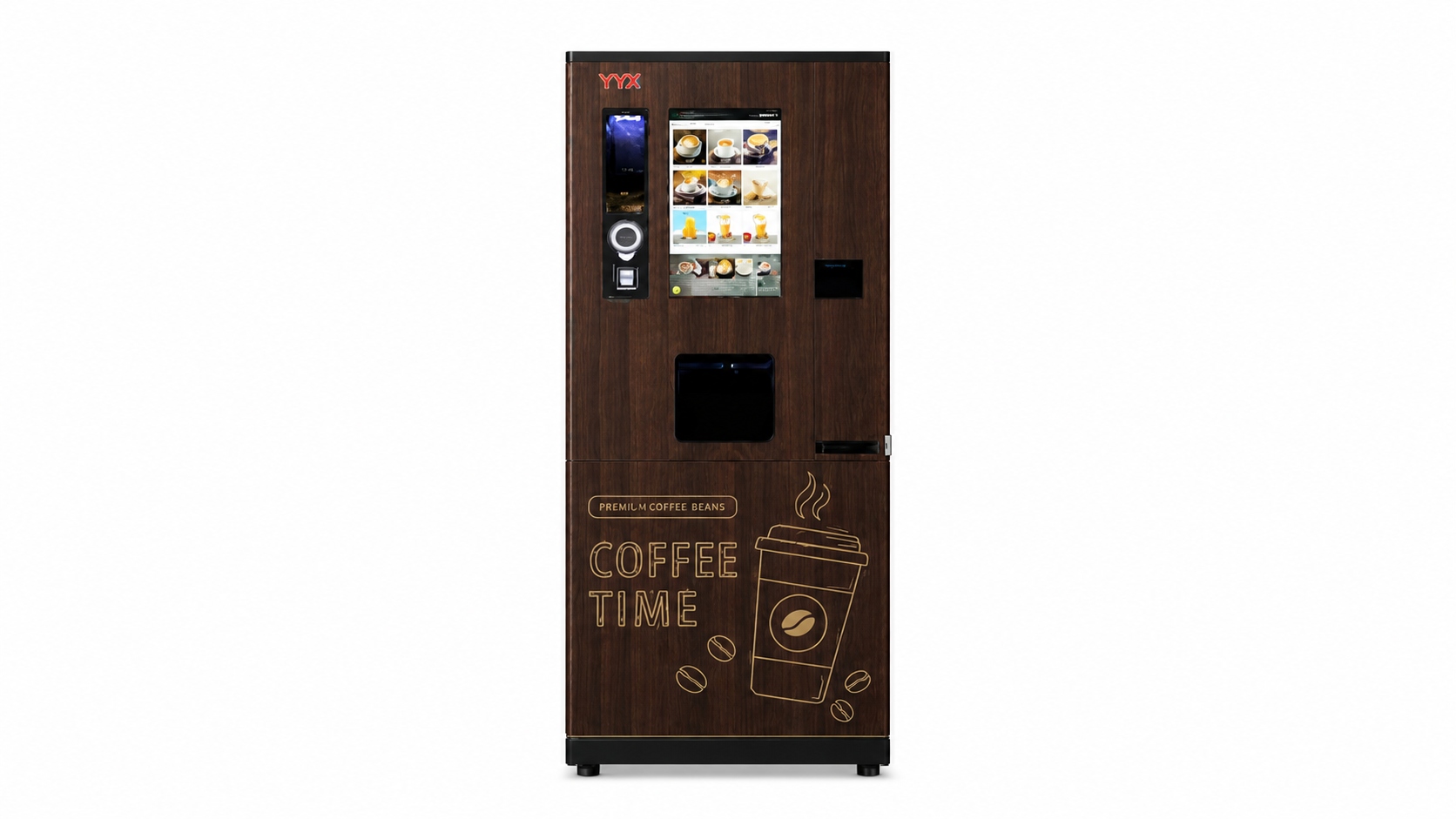
The featured commercial coffee vending solution uses a 64 mm vertical grinding system combined with a 5 L coffee bean hopper, helping operators maintain consistent grinding while reducing refill frequency. For locations targeting higher daily sales volumes, grinder durability becomes especially important.
B2B takeaway: Don't evaluate a coffee vending machine only by how many drinks it can offer. Evaluate whether it can produce those drinks consistently throughout the day.
2. MATCH MACHINE CAPACITY TO YOUR LOCATION
One of the most common vending mistakes is installing a machine that is too small for the location. Every additional refill trip costs time and labor. Before purchasing, estimate: expected cups per day → refill frequency → service labor → operating cost.
- 6 x 3.5 L ingredient canisters for milk powder, cocoa, vanilla, caramel, and other ingredients
- Up to 250 paper cups to reduce replenishment frequency
- 3 x 18 L bottled-water supply for locations where direct plumbing is difficult or expensive
Depending on configuration and recipes, operators can offer espresso, Americano, cappuccino, latte, mocha, hot chocolate, and flavored coffee drinks.
B2B takeaway: Capacity should always be matched to the expected traffic and service plan of each location.
3. MAKE ORDERING AND PAYMENT SIMPLE
The customer journey should be simple: see the menu → select a drink → pay → receive coffee. Every unnecessary step creates friction. For high-traffic commercial environments, a large touchscreen can simplify selection while providing space for promotions and digital advertising.
The featured solution uses a 27-inch touchscreen interface. Depending on project requirements, payment integrations may include:
- Credit/debit card payment
- Contactless payment
- QR-code payment
- Mobile payment
- Other local payment solutions
U.S. market note: Confirm that the selected payment configuration supports the methods your target customers already use.
4. REMOTE MANAGEMENT CAN REDUCE OPERATING COSTS
Managing one machine manually may be manageable. Managing 20, 50, or 100 machines is a different business. Remote management should therefore be considered early when evaluating a commercial vending platform.
- Machine status
- Sales performance
- Inventory levels
- Revenue
- Product performance
- Machine alerts
- Location performance
Connectivity options can include 4G, Wi-Fi, and Ethernet, depending on configuration and local infrastructure. Instead of visiting every location just to check stock or machine status, operators can use data to decide when and where service is actually needed.
“One machine is an equipment purchase. Fifty machines are an operations system.”
5. THINK ABOUT MAINTENANCE BEFORE YOU BUY
Purchase price is only one part of total cost of ownership. A lower-priced machine can become expensive if it requires frequent maintenance, cleaning, refilling, or technician visits.
- Internal component accessibility
- Cleaning procedures
- Ingredient refill process
- Waste-water management
- Waste collection
- Cup dispensing reliability
- Component replacement
- Remote troubleshooting
- Spare-parts availability
- Technical support
The featured commercial coffee vending machine uses a modular internal design so ingredient containers, waste containers, and other service areas can be accessed more efficiently. Approximate machine dimensions: 1850 mm (H) x 900 mm (W) x 980 mm (D).
WHICH LOCATIONS ARE BEST FOR COFFEE VENDING?
| Location | Typical Need | Recommended Focus |
|---|---|---|
| Offices & Corporate Buildings | Convenient coffee throughout the workday | Drink quality, easy operation, low refill frequency |
| Universities & Colleges | Long hours and cashless purchasing | Large capacity, cashless payment, remote monitoring |
| Hospitals & Medical Facilities | 24/7 availability | Reliability, easy cleaning, continuous operation |
| Shopping Centers | Higher traffic and sales potential | Capacity, fast service, remote management |
| Transportation Hubs | High-throughput demand | High capacity, reliable payment, reduced refill frequency |
DON'T BUY A COFFEE MACHINE. BUILD A COFFEE VENDING BUSINESS.
For B2B buyers, the most important question isn't simply, “How much does this machine cost?” A better question is: “How efficiently can this machine generate and support revenue over its operating life?”
COFFEE QUALITY + CAPACITY + PAYMENT + REMOTE MANAGEMENT + RELIABILITY + SERVICEABILITY
A well-selected machine can reduce labor requirements, simplify operations, and make it easier to expand from a single location into a larger unattended coffee network.
LOOKING FOR A COFFEE VENDING SOLUTION FOR YOUR MARKET?
YOUYIXUAN works with vending operators, distributors, and business partners to develop commercial unattended retail solutions for different markets and operating environments. Coffee vending projects can support market-specific configurations including:
- Branding and machine appearance
- Payment systems
- Ingredient and storage capacity
- Connectivity
- Software and remote management
- OEM / ODM requirements
Whether you're testing your first location or planning a multi-location vending network, the right machine configuration should be built around your actual business model.