



The strongest lesson from recent ASEAN business and entrepreneurship forums is simple: digital growth becomes commercially valuable only when the operating model is easy to use, affordable to maintain, and supported by capable local partners.
At the 2026 Indonesia Economic Forum, the theme “The Digital Archipelago” focused attention on inclusive digital commerce and better market access for small businesses. World Economic Forum discussions on ASEAN’s digital economy reached a similar conclusion: businesses need simplicity, speed, affordability, practical support, and interoperable systems. For smart vending, those principles translate directly into how machines should be owned, stocked, serviced, paid for, and scaled.
THE CORE PRINCIPLE: LOCAL OPERATIONS, CONNECTED TECHNOLOGY
A vending machine can be manufactured globally, but a successful vending network must operate locally. Product selection, permits, payment onboarding, refill routes, price points, consumer support, and technician response all depend on the local market.
The equipment supplier should therefore provide a reliable technical platform, while an Indonesian partner owns the day-to-day commercial relationship. Clear division of responsibility builds trust and makes performance easier to measure.
GLOBAL TECHNOLOGY WORKS BEST WHEN LOCAL OPERATIONS ARE CLEAR, RESPONSIVE, AND ACCOUNTABLE.
MODEL 1: LOCAL DISTRIBUTOR + OPERATOR NETWORK
A national or regional distributor imports equipment, develops sales channels, coordinates local installation and spare parts, and supports several downstream operators. Each operator manages locations, products, replenishment, and consumer service.
Best suited for: Equipment distributors, payment or retail-technology companies, and service organizations that already cover multiple cities.
Why it works: The distributor creates a local trust layer, while operators remain close to their sites. Youyixuan can support the hardware platform, configuration, technical documentation, training coordination, and remote troubleshooting framework.
MODEL 2: OPERATOR-OWNED, VENUE REVENUE SHARE
The operator purchases and manages the machines, while a mall, campus, hospital, office building, or residential property provides the location. The parties agree on fixed rent, a percentage of sales, or a hybrid commercial arrangement.
Best suited for: Experienced vending operators and entrepreneurs with strong access to high-traffic venues.
Why it works: The venue can add a service without investing in equipment or staffing, while the operator retains control over product mix and service standards. Remote data helps both parties review performance using agreed metrics rather than estimates.
MODEL 3: VENUE-OWNED MANAGED SERVICE
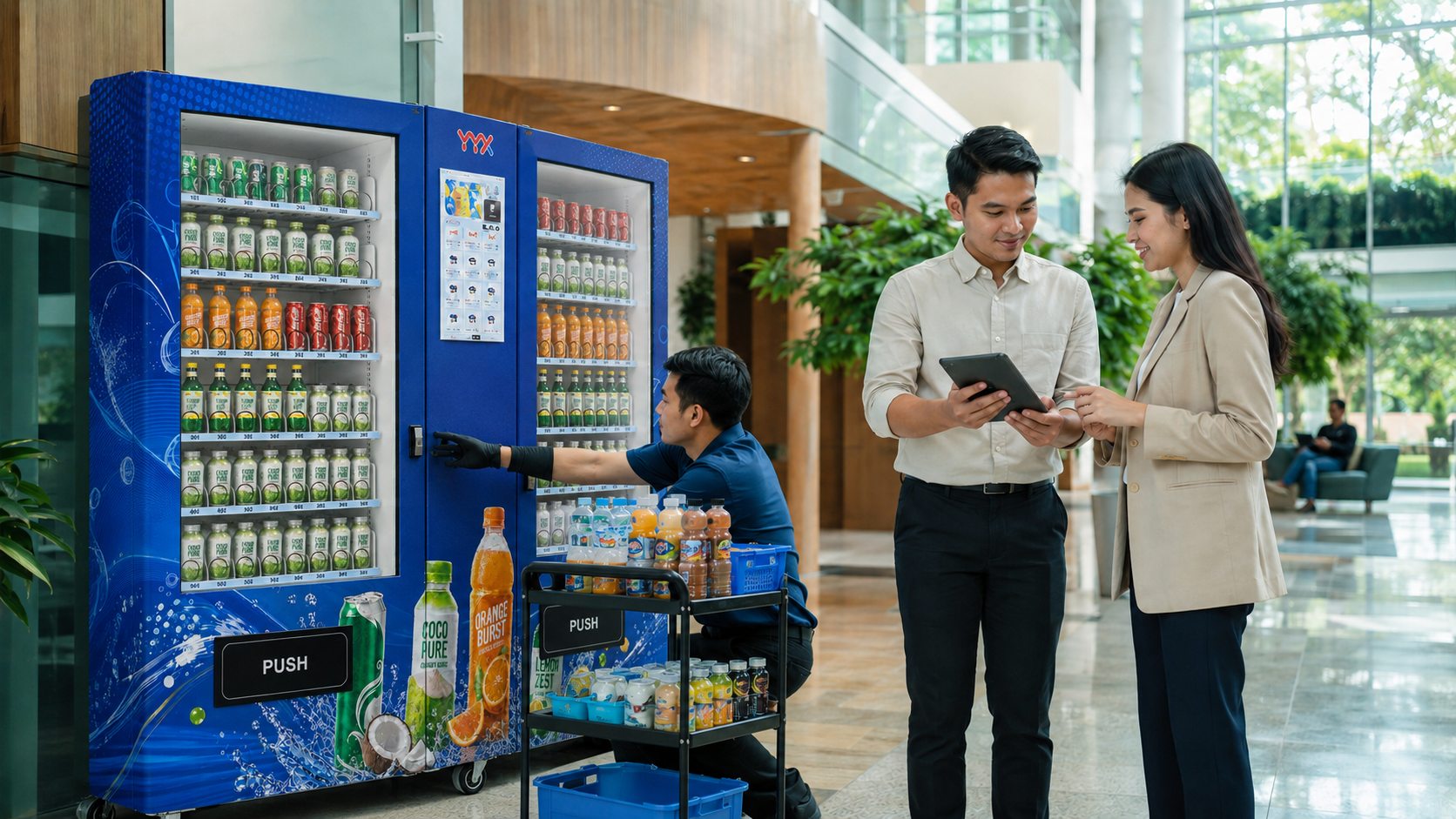
A property group, university, factory, transport operator, or hospitality business owns the machines but contracts a local team to replenish, clean, inspect, and maintain them under a service-level agreement.
Best suited for: Organizations that want the machines to remain part of their own asset base and customer experience.
Why it works: Ownership and brand control stay with the venue, while operational tasks are assigned to specialists. Connected management provides better visibility across a portfolio of sites.
MODEL 4: BRAND-LED AUTOMATED RETAIL
A food, beverage, beauty, flower, or lifestyle brand uses customized vending machines as compact automated outlets. The brand controls product, pricing, campaigns, and customer experience, while a logistics partner handles refill routes and field service.
Best suited for: Brands testing new neighborhoods, extending operating hours, or adding a physical channel without opening a full store.
Why it works: The machine becomes a controlled retail touchpoint rather than an anonymous cabinet. Youyixuan’s multi-category development capability, cabinet customization, temperature-management options, and connected operation can support a more differentiated format.
MODEL 5: PILOT JOINT VENTURE OR PROJECT PARTNERSHIP
A local investor or project company combines venue access and operating resources with equipment and technical support from the supplier. The partners begin with a limited pilot and define expansion conditions in advance.
Best suited for: New market entrants and specialty concepts where demand, product mix, or service frequency still needs validation.
Why it works: Risk is controlled and expectations are explicit. A useful pilot should define the number of machines, trial period, target locations, product categories, reporting method, service responsibility, and the data threshold required for expansion.
FOUR OPERATING SYSTEMS EVERY MODEL STILL NEEDS
Payment: Work with an authorized local payment provider to configure QRIS and any other required methods; confirm settlement ownership, fees, refunds, and reconciliation before launch.
Replenishment: Build refill routes around product shelf life, sales velocity, traffic patterns, and Indonesia’s climate; define inventory ownership and shrinkage responsibility.
Maintenance: Train local technicians, hold an agreed spare-parts stock, set response times, and use remote diagnostics to reduce avoidable site visits.
Compliance and customer service: Verify equipment import, electrical, food, halal, labeling, tax, and location-specific requirements with qualified Indonesian advisers; provide Bahasa Indonesia user guidance and a visible local support channel.
WHY YOUYIXUAN IS STRUCTURED FOR B2B COOPERATION
B2B customers need more than an attractive machine. They need a supplier that can discuss how the asset will earn, how it will be managed, and what happens after installation.
- A broad smart-vending portfolio allows partners to match equipment to specific venue economics and product categories.
- Remote equipment and order visibility supports multi-site management and more accountable operator relationships.
- Flexible cabinet, interface, connectivity, payment, and voltage configurations support localization at project level.
- Pilot planning helps partners validate assumptions before a larger capital commitment.
- Training, technical coordination, and after-sales support create a clearer path from delivery to stable operation.
The exact configuration, integration scope, service plan, commercial terms, and local responsibilities should be confirmed in writing for each project. This transparent approach protects both sides and creates the foundation for a long-term partnership.
THE RIGHT PARTNERSHIP CONNECTS HARDWARE, LOCAL OPERATIONS, AND LONG-TERM COMMERCIAL VALUE.
START WITH ONE REPEATABLE ROUTE
Indonesia’s scale can tempt new entrants to expand too quickly. A stronger method is to select one city, one operating model, one or two venue types, and a manageable cluster of machines.
Measure sales, gross margin, downtime, refill cost, payment success, product waste, and customer issues. Then optimize the model before entering the next city.
For local distributors, operators, property groups, and brands, Youyixuan is ready to discuss equipment selection, customization, pilot design, remote management, and technical support for Indonesian projects.
ONE CITY. ONE MODEL. ONE REPEATABLE ROUTE. THEN SCALE.
SOURCE CONTEXT
Indonesia Economic Forum — Press releases — 2026 Digital Archipelago and inclusive digital-commerce context.
World Economic Forum — What ASEAN’s small businesses need — Simplicity, affordability, practical support, and interoperability themes.
Bank Indonesia — QRIS — Official QRIS merchant onboarding and payment-system information.
World Economic Forum — ASEAN digital economy pact — Regional integration, digital payments, and trusted data-flow context.